FDA Human Foods Program 2026: Why Training Alone Isn't Enough for Food Safety Compliance
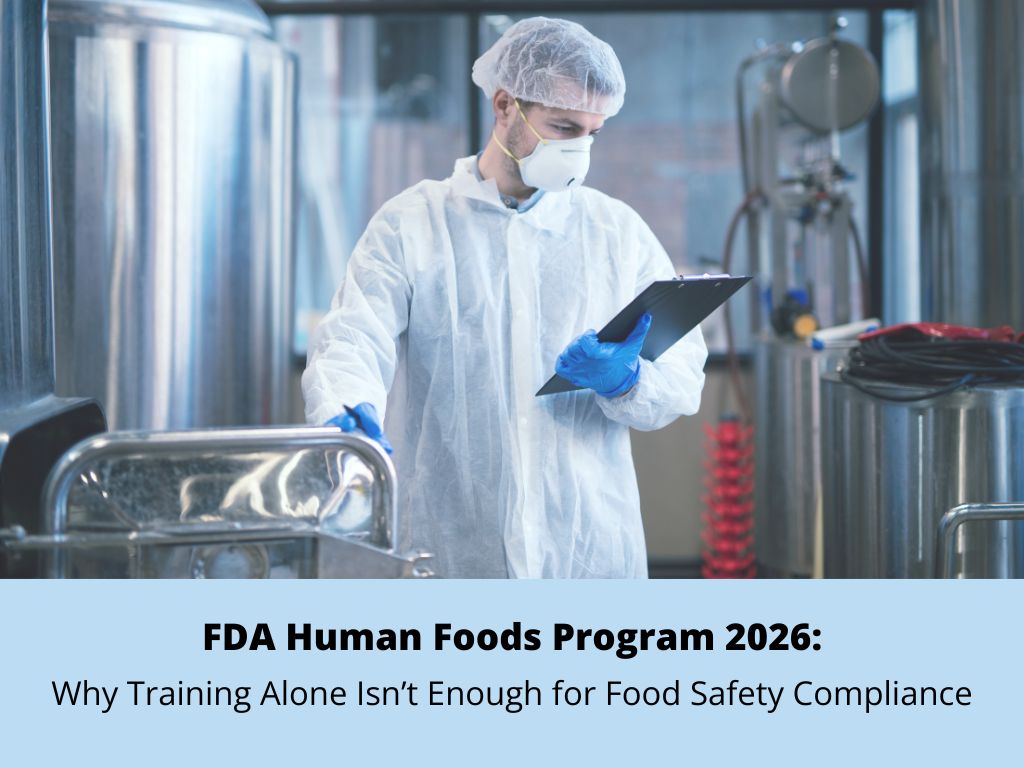
In January 2026, the U.S. Food and Drug Administration’s Human Foods Program (HFP) released its 2026 Priority Deliverables, outlining a broad regulatory agenda built around protecting public health by strengthening food safety systems, including microbiological risk reduction in food manufacturing. The plan emphasizes expanded inspection coverage and enhanced contamination prevention training and education for dairy, egg, and other food producers as foundational to preventing foodborne illness. (U.S. Food and Drug Administration)
The FDA Human Foods Program 2026 signals a clear shift toward greater accountability in food manufacturing compliance and preventive controls verification.
But there’s a critical tension emerging between regulatory expectations and what industry practice alone can reliably deliver.
Training and hygiene education, while essential, only go so far. Human behavior is inherently variable, and in high-throughput food production environments, compliance gaps can persist despite robust programs. Even with training on SSOPs (Sanitation Standard Operating Procedures), GMP (Good Manufacturing Practice), and HACCP verification, relying on manual compliance alone leaves a measurable gap in contamination control that inspection programs will increasingly expose.
The Unavoidable Gap in Human-Dependent Hygiene Controls
The FDA Human Foods Program 2026 priorities highlight contamination prevention training as a cornerstone of its inspection strategy. In dairy and egg sectors, for example, 2026 deliverables include high-risk dairy training courses for regulators and outreach for producers to strengthen preventive controls. (U.S. Food and Drug Administration)
In practice, however, training does not guarantee sustained behavior. Workers under production pressure may unintentionally skip steps or vary execution of sanitation protocols. We are only human, after all. Studies in behavioral compliance across manufacturing sectors consistently show that self-reported or training-based compliance does not always translate into consistent execution on the floor, particularly during peak production periods or staffing gaps.
That’s where environmental and automated hygiene controls become essential complements (not substitutes) to human training.
A Real Case: Hygiene Compliance at Lone Star Dairy Products
A practical example comes from dairy processing. At Lone Star Dairy Products (a large dairy plant processing millions of pounds of milk daily), proactive intervention was needed to move beyond manual hygiene practices to deliver measurable improvement in compliance metrics. (patho3gen.com)
Before automation, hygiene compliance rates in transition zones were inconsistent. After implementing UVZone® UV-C + ozone sanitation stations at key personnel entry points:
- Hygiene compliance increased from ~56% to 96% in six months
- A 40% overall improvement was documented
- Temporary removal of the stations led to immediate declines in compliance, illustrating how the technology directly influenced behavior and outcomes (patho3gen.com)
This isn’t just anecdote; it’s evidence that process-integrated controls can materially improve hygiene performance where manual compliance alone has reached its limits.
Why Automated Environmental Controls Matter in 2026
FDA’s 2026 strategy reinforces contamination prevention through inspections and training. Yet inspections will inevitably uncover what human behavior leaves unguarded:
- Missed or variable execution of sanitation steps
- Gaps between procedures “on paper” and performance “in practice”
- Environmental pathogen vectors that human-dependent hygiene alone cannot fully control
In this context, hygiene technologies that augment human efforts and provide verifiable, reproducible sanitation steps help manufacturers not only satisfy regulatory expectations but demonstrate preventive control validation to auditors and inspectors.
From Training to Reliable Prevention
Training is necessary but not sufficient on its own. When companies embed measurable, automated hygiene controls into production workflows, they:
- Close compliance gaps that human variability creates
- Generate traceable performance records to support inspections
- Strengthen contamination control beyond procedures alone
As the FDA’s 2026 Human Foods Program accelerates inspection activity and contamination prevention expectations, food processors who combine best-in-class training with engineered sanitation controls will be better positioned to meet scrutiny and protect consumer safety.
Key Takeaway
Training alone cannot guarantee consistent food safety compliance. Automated and environmental hygiene controls are essential to close human behavior gaps, provide measurable results, and ensure reliable contamination prevention in line with the FDA’s 2026 Human Foods Program priorities.
FAQ: FDA Human Foods Program 2026
What is the FDA Human Foods Program 2026?
The FDA Human Foods Program 2026 outlines expanded inspection coverage and strengthened preventive controls to reduce microbiological risk in food manufacturing.
Will FDA inspections increase in 2026?
Yes. The program aims to expand the inspection of food processing facilities by leveraging state inspection resources to complement FDA inspections.
Is contamination prevention training enough for compliance?
Training is foundational, but human variability can create compliance gaps. Many facilities are strengthening preventive controls with automated environmental safeguards.
How can food manufacturers improve inspection readiness?
Facilities can improve inspection readiness by combining structured training with measurable, repeatable hygiene controls that support preventive controls validation.